Pearson Edexcel · A-Level · Mathematics
Course version: 9MA0 · Version from Mar 2026
Locate roots of f(x) = 0 by considering changes of sign of f(x) in an interval of x on which f(x) is sufficiently well behaved; understand how change of sign methods can fail
A sign-change argument is a compact proof that a root exists, not a guess from a calculator. Master B-S-C-C, and you can secure marks for locating roots, proving decimal-place accuracy and explaining exactly when numerical methods can mislead.
- 9 min read
- 4 worked examples
- 6 practice questions
- 8 key terms
Check what you remember
Read the wording for your board, then hide it and explain root (zero) in your own words. Rough notes are fine. This is a self-check, with no mark or grade.
Reference: Pearson Edexcel
A value c of x for which f(c) = 0.
Study Notes

Locating roots by a change of sign
Overview
This Pearson Edexcel A-Level Mathematics topic asks candidates to locate, rather than necessarily calculate exactly, a solution of (f(x)=0). The method is a short proof: evaluate a function at two carefully chosen values of (x), look for opposite signs, and use continuity to justify why the graph must meet the (x)-axis in between. It is assessed in numerical methods, but it also calls on algebra, graphs, functions, logarithms, exponentials and calculus.
The command word is often show. That means a calculator display alone is not enough. Examiners award marks for a correct pair of endpoint values, recognition that their signs differ, and a valid conclusion based on continuity. Questions can then use the interval as a starting point for iteration or Newton-Raphson, or ask candidates to prove that a displayed decimal is correct to a stated accuracy. Pearson Edexcel specification point 9.1 also requires you to explain where the method can fail. A high-scoring answer is precise about both its power and its limits.
Key concepts
1. A root is where the function is zero
A root of (f(x)=0) is a number (c) for which (f(c)=0). On a graph of (y=f(x)), it is an (x)-intercept. The change-of-sign method does not normally give the exact value of (c). It gives a reliable interval that contains at least one root.
For example, let (f(x)=x^3-x-1). Then (f(1)=-1), while (f(1.5)=0.875). The function value changes from negative to positive as the input moves from 1 to 1.5. This makes ((1,1.5)) a candidate interval for a root.
2. The sign-change theorem used in exams
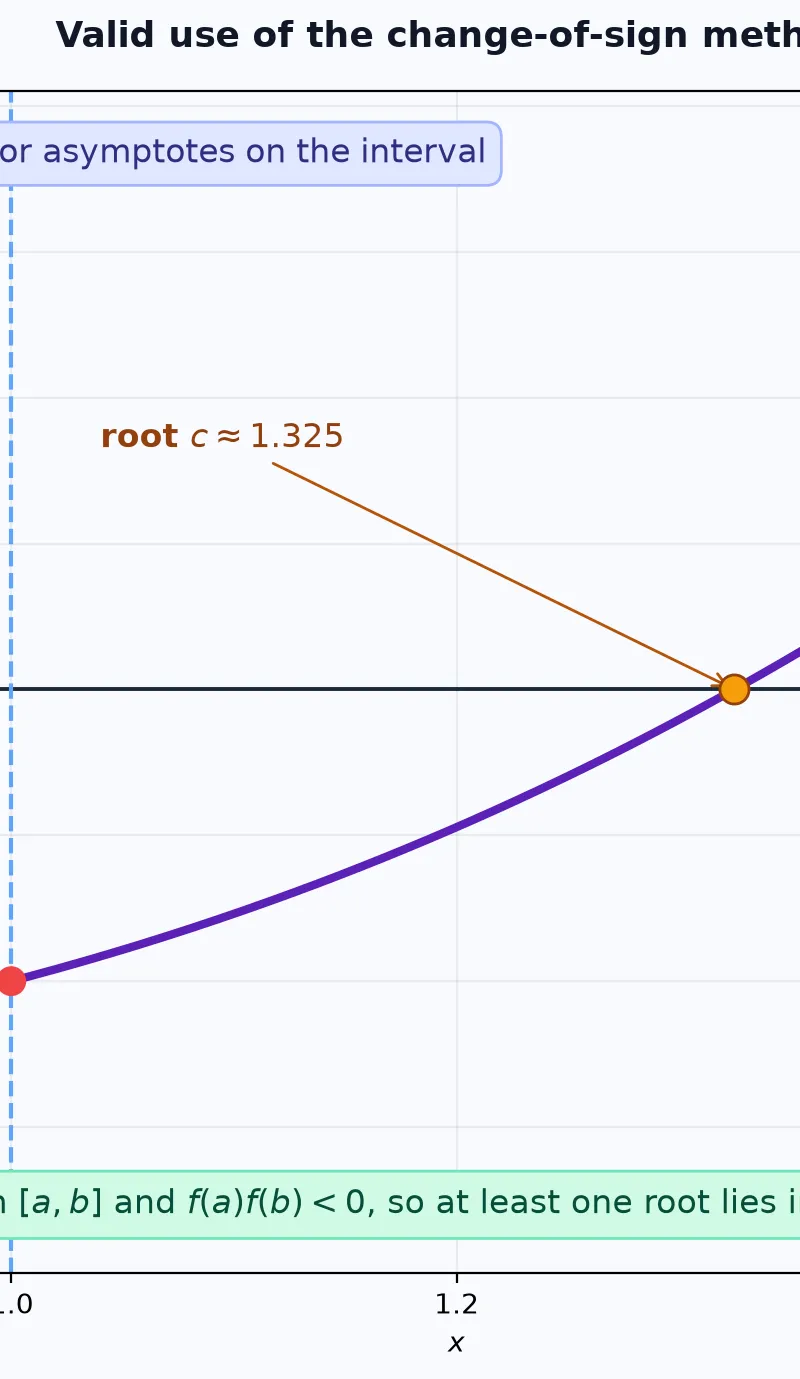
If (f) is continuous on ([a,b]), and (f(a)) and (f(b)) have opposite signs, then there is at least one root (c) with (a<c<b). A compact test is (f(a)f(b)<0). The inequality works because a positive number multiplied by a negative number is negative.
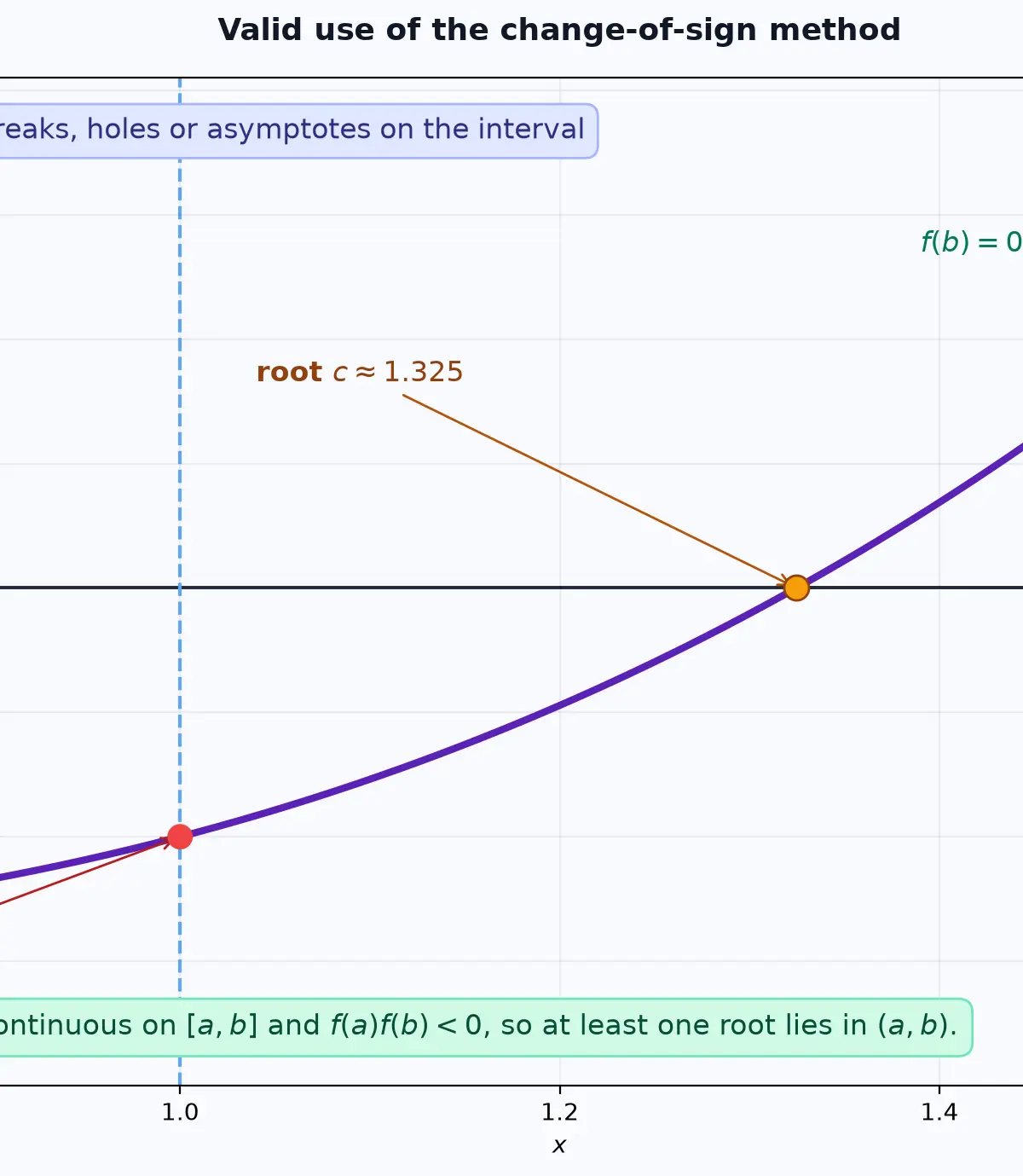
Continuity is the decisive condition. Informally, the curve has no break, gap, hole or vertical asymptote between (a) and (b). A continuous curve that begins below the (x)-axis and ends above it has to cross the axis. In an exam, do not rely on a sketch as proof. State the condition explicitly: “Since (f) is continuous on ([a,b]) and the function values have opposite signs, there is at least one root in ((a,b)).”
3. The four-line exam routine
Use B-S-C-C: Bounds, Signs, Continuity, Conclusion.
- Bounds: write the two supplied endpoints, or derive the rounding bounds.
- Signs: calculate (f(a)) and (f(b)), retaining enough digits to show one is positive and one negative.
- Continuity: state why the function is continuous on the whole interval. A polynomial is continuous for all real (x); for a logarithm or rational function, check its domain first.
- Conclusion: write “there is at least one root” and state the exact interval.
This phrasing is not decoration. In a typical 3-mark show-that part, candidates commonly receive credit for the endpoint calculations, the sign change, then the justified conclusion. Writing only “sign change” is incomplete. Writing “one root” overclaims what the method proves.
4. Proving an answer correct to decimal places
For a displayed value (r) correct to (d) decimal places, the root must lie in the rounding interval
[
r-\tfrac12\times10^{-d}\leq \alpha <r+\tfrac12\times10^{-d}.
]
For (1.325) correct to 3 decimal places, use ([1.3245,1.3255)). Test the function at the two bounds. If the values have opposite signs and the function is continuous, the root lies in that interval. Every number in the interval rounds to (1.325) to 3 decimal places, so the stated accuracy is established. The lower bound is inclusive and the upper bound is exclusive because standard rounding sends an exact half upward.
5. What the method proves, and what it does not prove
A valid sign change proves existence, not uniqueness. A continuous function may cross the axis once, three times, or another odd number of times between endpoints with opposite signs. If a question asks for exactly one root, add a separate uniqueness argument, for example showing (f'(x)>0) across the interval so that (f) is strictly increasing.
Likewise, no sign change does not prove that no root exists. A wide interval can contain two crossings. The function can change sign at the first root and change back at the second, leaving the endpoints with the same sign. A root at which the graph only touches the axis, such as (f(x)=(x-2)^2), is also invisible to an endpoint sign test because both nearby values are positive.
6. How change-of-sign methods can fail
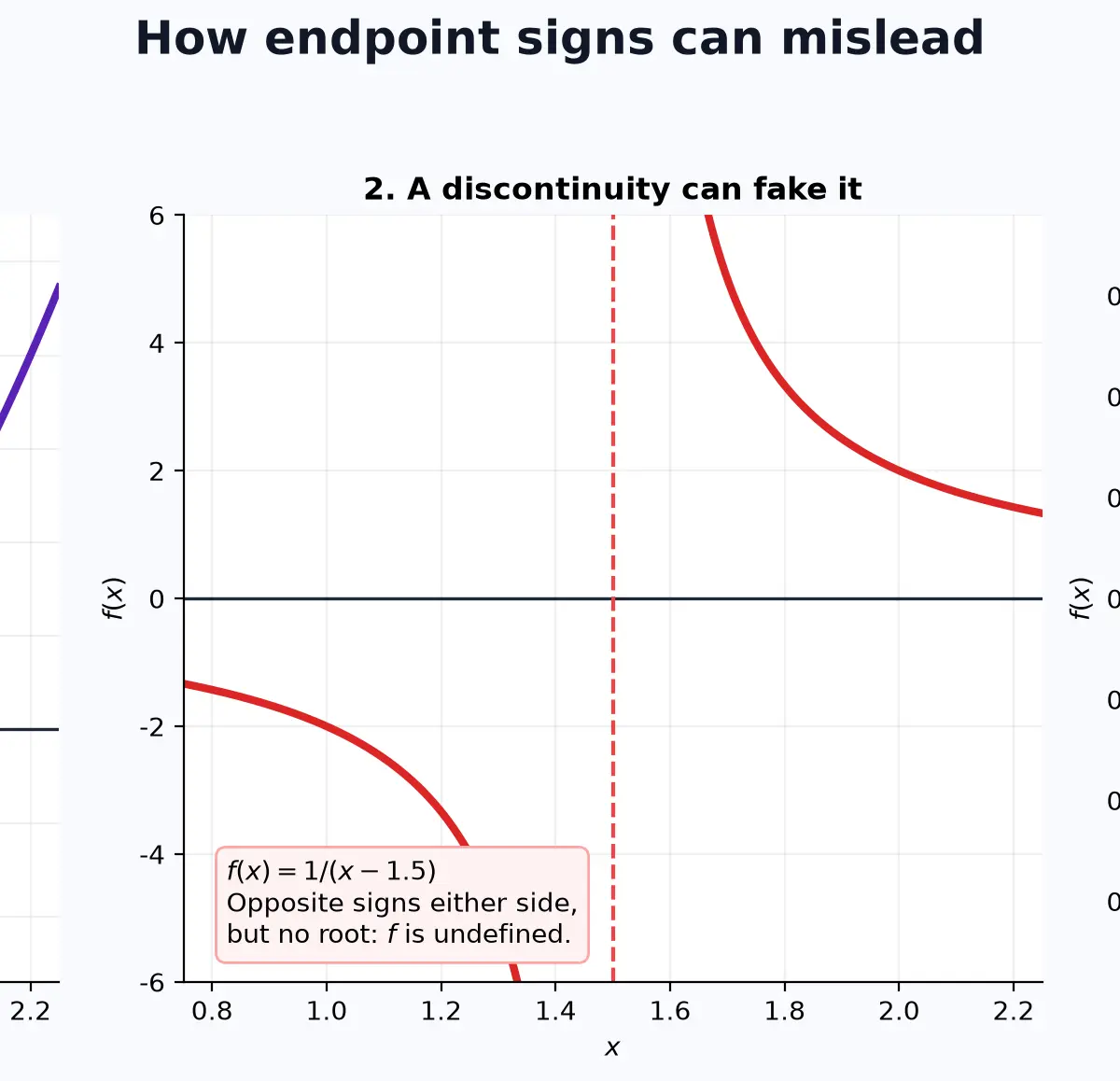
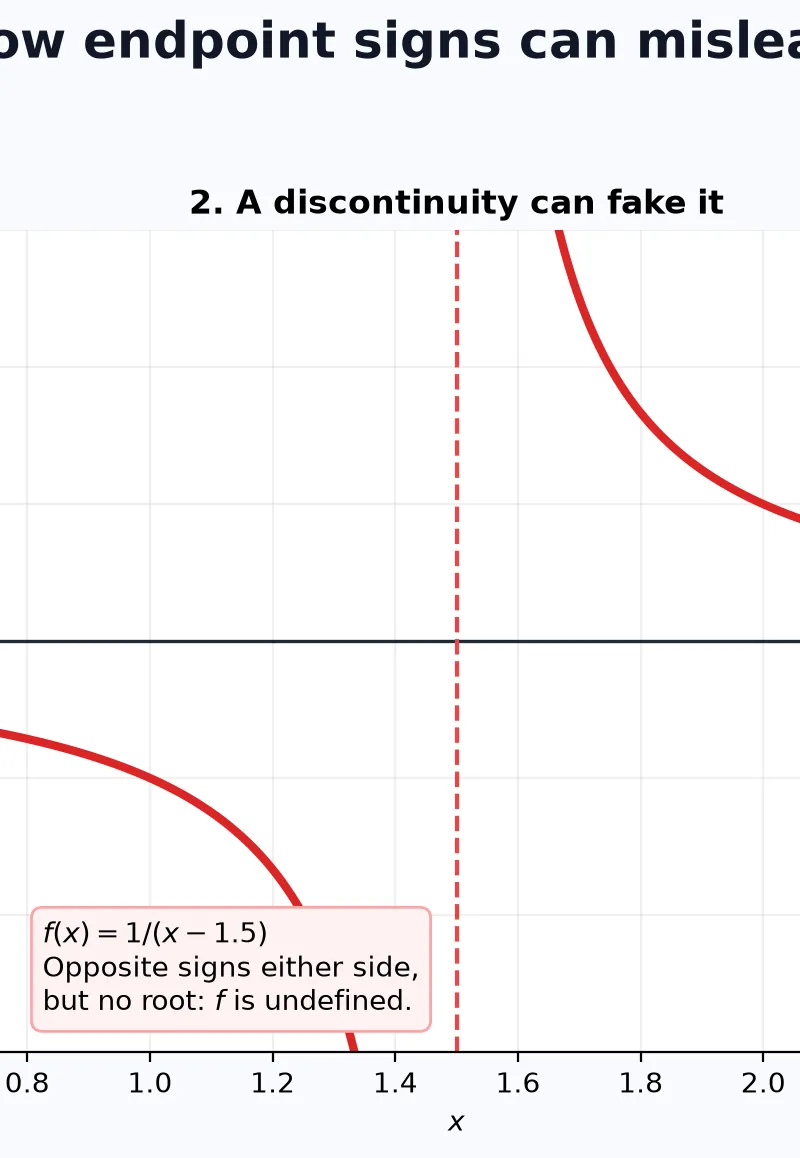
There are three cases candidates should be able to explain precisely.
A large interval can hide an even number of roots. If the curve crosses twice inside the interval, the endpoint signs may match. The correct statement is: “There may be an even number of roots in the interval, so no endpoint sign change is detected.”
A discontinuity can create a false sign change. For (f(x)=1/(x-2)), (f(1)=-1) and (f(3)=1). The signs are opposite, but there is no root in ((1,3)). The function is undefined at (x=2), where there is a vertical asymptote. The change is across a break, not through zero. This is why continuity must hold on the whole interval.
A sign change does not count roots. A sign table alone cannot distinguish one root from three. To justify exactly one root, use a further condition such as monotonicity, a graph supplied in the question, or derivative analysis.
Mathematical relationships and formulae
| Relationship or method | Meaning and use | Formula-sheet status |
|---|---|---|
| (f(c)=0) | Defines a root (c). | Must understand and use |
| (f(a)f(b)<0) | Endpoint values have opposite signs. Use only after confirming continuity on ([a,b]). | Must memorise |
| (a<c<b) | The root lies strictly between endpoints when neither endpoint is itself a root. | Must understand and use |
| (r-\tfrac12\times10^{-d}\leq\alpha<r+\tfrac12\times10^{-d}) | Rounding bounds for a value (r) quoted to (d) decimal places. | Must memorise |
| (f'(x)>0) or (f'(x)<0) | Shows strict monotonicity, which can support a separate uniqueness argument. | Must understand and use |
No special sign-change formula is supplied in the Pearson Edexcel formula booklet. Learn the wording and the logic. The calculator supports the evaluations, but it does not replace the explanation.
Graph and calculator skills
Choose a small interval around the expected root. A graph or table can help you choose it, but the algebraic sign check provides the formal argument. Use full calculator precision internally, then show enough digits for the sign. Never round a small negative number to (0) before deciding its sign. When entering an expression such as (x^3-3x^2-2x+5), use brackets for negative inputs and check whether the calculator is in the required angle mode if trigonometric functions appear.
Before invoking the rule, check the domain. Polynomials and exponentials are continuous for all real (x). A logarithm such as (\ln(x-1)) is continuous only for (x>1). A rational function is continuous only where its denominator is non-zero. Trigonometric functions such as (\tan x) have breaks at their vertical asymptotes. These checks are often the whole point of a failure question.
Practical applications and synoptic context
Numerical root location occurs whenever a model produces an equation that cannot conveniently be rearranged. Examples include finding the time when a moving object reaches a particular position, identifying a break-even point in a continuous model, or locating a turning point by applying the method to (f'(x)=0). In subsequent numerical-methods questions, the interval helps choose a sensible starting value for iteration or Newton-Raphson. The locating step is the evidence that a solution is nearby; it is not itself a method for producing many decimal places.
Examiner-style decision making
When a question gives the phrase “without using a graph”, it is signalling that the sign-change proof, rather than a visual assertion, is required. A graph may help you choose endpoints, but your answer must stand without it. Write the function values as calculations, not just rounded calculator outputs. For example, (f(1.6)=5-e^{1.6}=0.0469\ldots>0) makes the sign unambiguous and exposes the correct substitution.
$Treat the word continuous as a claim that needs an appropriate reason. For a polynomial, “(f) is a polynomial, hence continuous for all real (x)” is enough. For (\ln(x-1)), say that the entire interval lies in (x>1), where the function is defined and continuous. For a rational function, explicitly check that its denominator is not zero anywhere between the two endpoints. Credit can be given for a concise domain observation when it is relevant; it cannot be assumed across an asymptote.$
If an endpoint itself gives (f(a)=0) or (f(b)=0), you have directly found a root at that endpoint. Do not force a sign-change argument. State the root and check the question’s wording. Conversely, if both endpoint values are non-zero but have equal signs, the responsible conclusion is simply that the method gives no guarantee for that interval. It is not evidence that there are no roots. This distinction is a frequent source of explanation marks.
Use inequality notation carefully. From (f(a)<0) and (f(b)>0), conclude (a<\alpha<b), not (a\leq\alpha\leq b), unless an endpoint has itself been shown to be a root. For a rounded result, retain the lower-inclusive and upper-exclusive convention. These small notation choices show the examiner that you understand both the numerical and logical claim you have made.
Listen and revise
Play the companion ten-minute podcast, then cover the checklist and reproduce the B-S-C-C proof structure from memory.
Visual Resources
2 diagrams and illustrations
Interactive Diagrams
2 interactive diagrams to visualise key concepts
Conceptual Flow Outline
The safe B-S-C-C decision path for a sign-change proof.
Conceptual Flow Outline
The three limitations that candidates should distinguish in explanation questions.
Worked Examples
4 worked examples — open one to explore the question and available guidance.
Practice Questions
Try the question, then reveal an answer plan or example response
Let f(x) = 5 − eˣ. Show that f(x) = 0 has a root in 1.6 < x < 1.7.
Hint: Evaluate f at 1.6 and 1.7, then state why an exponential function is continuous.
Explain why equal signs at f(a) and f(b) do not prove that f(x) = 0 has no solution in (a,b).
Hint: Think of a curve that crosses the x-axis twice, or one that only touches it.
For f(x) = x⁴ − 5x + 1, show that a root is 1.64 correct to 2 decimal places.
Hint: Write the half-unit bounds around 1.64 before using the calculator.
A candidate applies the sign-change method to tan x on 1 < x < 2 because tan(1) > 0 and tan(2) < 0. Explain why this does not prove there is a root in the interval.
Hint: Locate π/2 relative to the interval.
Show that x³ + x − 7 = 0 has exactly one root in 1 < x < 2.
Hint: Use a sign change for existence, then differentiate for uniqueness.
A function is continuous on [−2,2], with f(−2) = 4 and f(2) = 4. What can and cannot be concluded about roots in the interval?
Hint: Separate the absence of a detected sign change from proof of absence.
Exam technique
How to turn what you know into marks
How to approach the question
Underline the interval or stated accuracy. Define f(x) if useful, calculate both endpoint values with clear substitution, identify their signs, check continuity on the entire interval, then conclude ‘at least one root’ in the stated interval. For accuracy, create the half-unit rounding bounds before evaluating.
How to structure your answer
For 3 marks: two endpoint values plus a concise continuity-and-conclusion sentence. For 4-5 marks: add the derivation of rounding bounds, a domain check, or a specific explanation of a failure case. If asked for one root, add a separate monotonicity or derivative argument; a sign change alone is insufficient.
Timing
Pearson Edexcel A-Level Mathematics papers are 2 hours for 100 marks: approximately 1.2 minutes per mark. A 3-mark locating-roots part should take roughly 3-4 minutes, including the written justification.
Common pitfalls
- Writing ‘there is one root’ rather than ‘at least one root’. Avoid it by treating existence and uniqueness as separate claims.
- Using a sign change across a discontinuity. Avoid it by checking denominators, logarithm arguments and tangent asymptotes inside the interval.
- Using incorrect rounding bounds, such as 1.324 and 1.326 for 1.325 to 3 decimal places. Avoid it by moving exactly 0.0005 either side.
- Rounding a small negative calculator value to zero before reading its sign. Avoid it by keep enough decimals or using < 0 and > 0 notation.
What the command words want
- Compare
- Say what a sign change guarantees and what it does not: it proves at least one root, whereas no sign change does not prove no roots.
- Explain
- Give a cause-and-effect statement: the function is discontinuous, so the sign change may be across an asymptote rather than a root.
- Describe
- Describe the sign pattern or graph behaviour using precise terms such as ‘crosses the x-axis’, ‘touches’, ‘continuous’ or ‘vertical asymptote’.
- Evaluate
- Weigh the evidence. A sign change is strong evidence only with continuity on a small interval; state the limitation before giving a judgement.
- Calculate
- Show both substitutions, use brackets, and retain enough digits to establish the signs. A calculator value without working may not earn method marks.
- State/Give
- Give the requested interval or value directly, but preserve the stated inequality notation.
Watch or listen (optional)
Test your understanding of Locate roots of f(x) = 0 by considering changes of sign of f(x) in an interval of x on which f(x) is sufficiently well behaved; understand how change of sign methods can fail
Active recall beats re-reading. Take an instant quiz now to test what you’ve learned and lock it into long-term memory.
7 days Premium · Then the free plan continues · No card, no charge